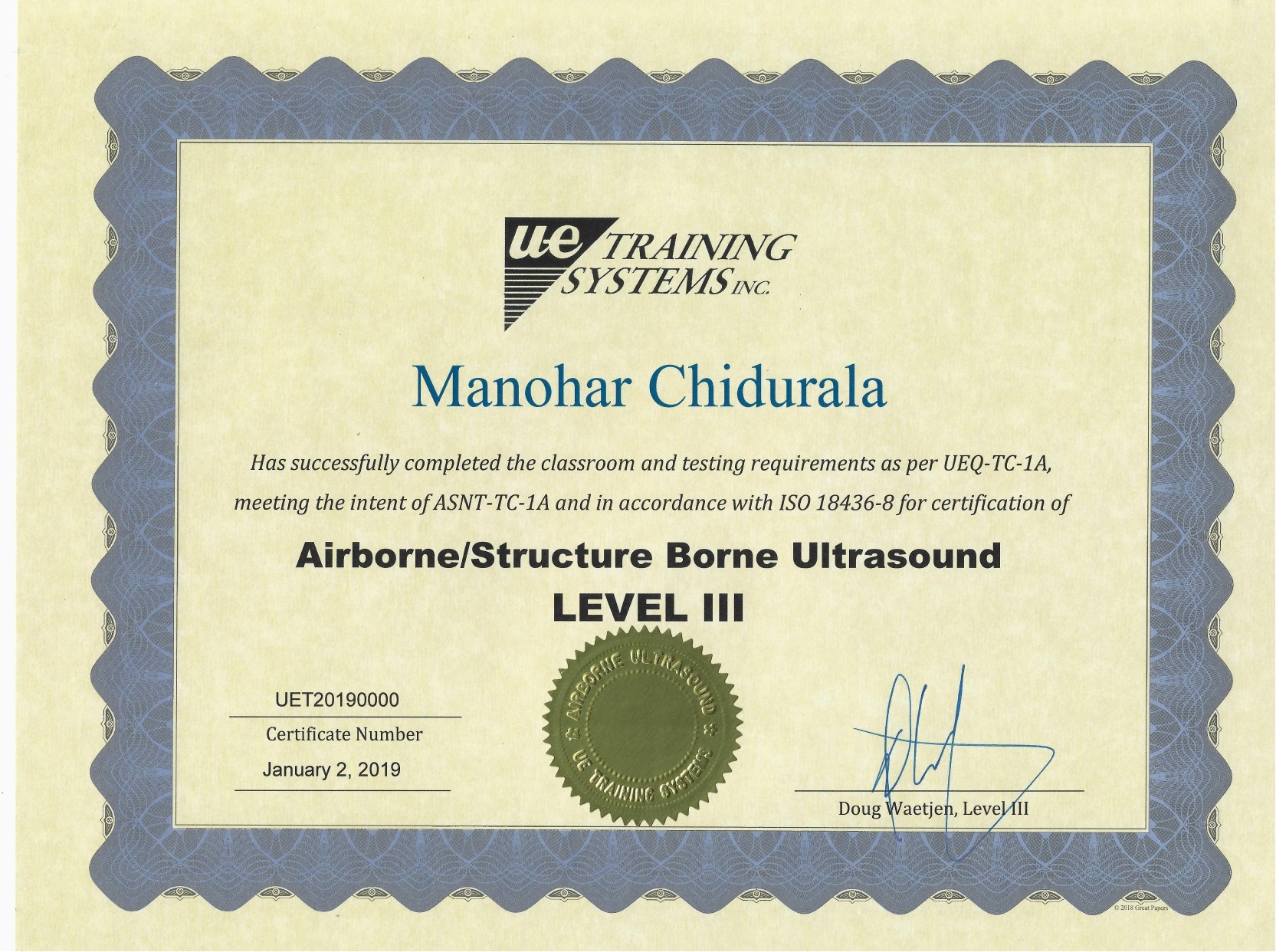
Level II Ultrasound Certification Course
The Level II Ultrasound Certification Course is designed for certified Level I professionals seeking advanced knowledge in ultrasonic inspection, diagnostics, and program implementation. The course focuses on advanced data analysis, condition monitoring strategies, and the development of effective reliability programs.
Participants will gain expertise in advanced inspection techniques, sound analysis, procedure development, and equipment calibration while learning how to establish and manage comprehensive ultrasound inspection programs.
What You Will Learn
- Advanced Airborne and Structure-Borne Ultrasound Theory
- Advanced Leak Detection and Cost Analysis
- Electrical Inspection and Spectral Analysis
- Mechanical Diagnostics and Bearing Analysis
- Advanced Steam Trap and Valve Inspection
- Data Collection, Trending, and Sound Analysis
- Procedure Development and Program Implementation
- Advanced Reporting and Reliability Improvement Strategies
RENVIRO Systems Course Description: Cat 2
CAT 2 is an advanced course that requires students to meet CAT 1 requirements before enrolments
This 32-hour course is designed in accordance with ISO 18436-8 and meets with the intent of ASNT-SNT-TC-1A. Students successfully completing this course will be familiar with the scope and limitations of Airborne/Structure Borne Ultrasonic Inspection, able to set up and calibrate equipment, able to interpret and evaluate results with respect to applicable codes, standards, and specifications, and organize and report inspection results. This class focuses on building procedures and programs as well as analysis of sound waves using Fast Fourier Transform and Time Waveform.
Course content consists of:
- Advanced Theory of:
- Airborne/Structure Borne Ultrasound
- Compressed Gas Leaks
- Electrical
- Mechanical (Valves, Steam Traps, Bearings, Lubrication, Gears, Pumps)
- Advanced Inspection Logistics
- Condition Monitoring Principals
- Best Practices of Data Collection
- Data and Sound Analysis
- Writing and Establishing Procedures
- Program Implementation
- Generating Reports
- A General, Specific, and Practical exam is given at the end of the course.
Requirements for Level II Certification
To achieve an official certification, one must attend certification training (32 hours of lecture training) and must pass the General, Specific and Practical examinations with a combined score of 80% or better. Documentation of education or experience must be maintained annually. Hearing acuity must meet the minimum requirement of one ear of less than 25 dBHL at 500 Hz to 4 kHz (with or without aid.) Hearing acuity examinations must be documented annually. Documented experience signed by a supervisor or superior for 6 months additionally of the Level I experience of 6 months, for a cumulative 12 months’ experience to qualify for official certification of Level II.
Candidate Must Haves
Each Candidate for Level II certification of Airborne/Structure Borne Ultrasound should:
- Be Proficient with their ultrasonic device.
- Be Proficient with collecting data in the field.
- Be proficient in explaining the use cases from your relevant application during the training program. Be proficient in explaining the use cases from your relevant application during the training program. This document must be recorded for evaluation.
- Basic Working Knowledge of Level I Material of Airborne/Structure Borne Ultrasound.
Airborne/Structure Borne Level II Course Outlook
MONDAY (8hrs)
ASNT SNT-TC-1A, ISO 18436-8, UEQ-TC-1A
Review of Level I Theories and Concepts
Sound Theory and Condition Monitoring
Ultrasound Theory, Low Frequency versus High Frequency Sound Characteristics, Acoustic Impedance, Reflection, Absorption, Scattering, Attenuation, Inverse Distance Law; Sources of Ultrasound. Definitions of Frequency, Decibel, Sensitivity. Deeper Understanding of Heterodyning, Time Wave Form, FFT – Fast Fourier Transform Decibel vs FFT/Time Wave Form.
Principals of Conditioning Monitoring.
Thermography, Vibration Analysis, Oil Analysis, Motor Circuit Analysis.
The P-F Curve.
Equipment Condition and Times.
Understanding Cost.
Ultrasound in Condition Monitoring
Switching from Time-based Lubrication to Condition-based Lubrication.
Best Practices of Condition Monitoring
Following Procedure, Timelines, Criticality Analysis, Failure Mode Analysis, Route Building, Repeatability
Spectral Analysis Software
Project Assignment of an outline of an Ultrasonic Procedure/Program due Thursday afternoon.
Practical Quiz of Day’s Lessons
Tuesday (8 hrs)
Data Collection -Best Practices of Data Collection, Data Collection with Airborne Structure Borne Ultrasound.
Compressed Gas-Leak Inspection, Leak Inspection Strategies, SAFETY, Pressure & Vacuum Leaks, Procedure, – Compressed Air Leak Survey, Reporting, Hands on Practice of Cost Analysis and Reporting
Electrical Inspection.
Electrical Inspection, SAFETY, Analyzing Corona/Tracking/Arcing, Discharge Points of Tracking and Arcing, Loose Vibrating Components, Performing Inspection, Establishing a Procedure, Important Considerations, Troubleshooting/Base line Procedures, Trending Procedures.
Practical -Hands on Practice Analyzing sound files of Electrical Anomalies in Spectrlayzer Software.
Practical Quiz of Day’s Lessons
Wednesday (8 hrs)
Valves
Cavitation and Flashing in Valves, Write the Procedure, Reporting.
Steam Trap Inspection
Steam Trap Function, Type of Traps: Mechanical, Inverted Bucket, Float,
Float and Thermostatic, Thermostatic, Metal Expansion, Balance Pressure Bellows, Bi-Metallic, and Thermodynamic.
Reasons Why Steam Traps Fail; Steam Trap Inspection; SAFETY.
Hands on Practice of Steam Trap Analysis in Spectrlayzer software and Reporting through DMS
Practical Quiz of Day’s Lesson
Thursday (8 hrs)
Bearing Inspection
Bearing Dynamics: What is a Bearing? Bearing Failure Mechanisms, Bearing Inspection, Mechanical Testing Best Practices, Inspection Methods, Mechanical Inspection Trending.
Recommended Procedure for Ultrasonic Analysis and Lubrication of Bearings
Basic Lubrication Principles, Lubrication with Ultrasound, Proper Steps Using Ultrasound to Lubricate, Over Lubrication, Lubrication Procedures, Switching from Time-based Lubrication to Condition-based Lubrication, Mechanical Inspection Safety Tips;
Hydraulic Inspection.
Pumps and Cavitation.
Gear Boxes and Using a Time Wave Form Spectral Analysis.
Hands on Practice of UE Spectrlayzer analyzing mechanical faults.
Hands on Practice of Generating Reports.
Practical Quiz of Day’s Lessons
Individual Written Ultrasonic Procedure/Program Outline Submitted
Review of Weeks Material for Final (45min)
Friday (4 hrs)
2-hour Final Examination (multiple choice questions).
| Training Schedule and Practical field data collection activities | ||
|---|---|---|
| Sl.no | Description | Timings |
| 1 | Start Time | 9:30 AM - 10:00 AM |
| 2 | Coffee Break | 11:15 AM - 11:30 AM |
| 3 | Lunch Break | 01:00 PM - 02:00 PM |
| 4 | Sensitivity validation procedure | 02:00 PM - 02:30 PM |
| 5 | Afternoon Training session | 02:30 PM - 03:30 PM |
| 6 | Practical field data collection/analysis | 03:30 PM - 04:30 PM |
| 7 | Coffee Break | 04:30 PM - 04:45 PM |
| 8 | End of day | 04:45 PM - 05:45 PM |
Outcome:
Upon successful completion, participants will be capable of conducting advanced ultrasonic inspections, analyzing inspection data, developing inspection procedures, implementing reliability programs, and mentoring Level I ultrasound technicians within industrial maintenance environments.