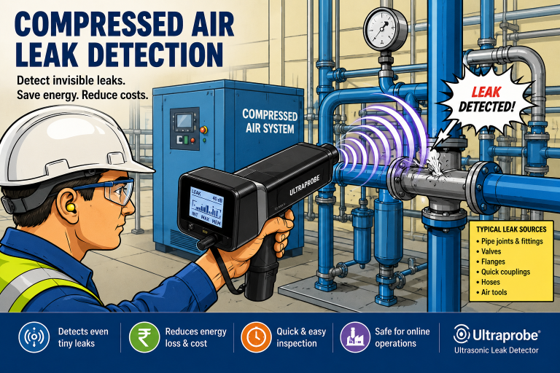
LEAK DETECTION
Ultrasound & Acoustic Leak Detection
Ultrasound and Acoustic Leak Detection are predictive maintenance techniques used to identify leaks in compressed air systems, gas lines, vacuum systems, steam traps, and pressurized equipment by detecting the sound generated by turbulent flow through leak points.
Ultrasound Leak Detection
Ultrasound leak detection uses high-frequency sound waves, typically above the human hearing range (>20 kHz), produced when gas or air escapes from a pressurized system.
Working Principle: (Heterodyne)
When compressed gas passes through a leak path:
- Turbulence is generated.
- The turbulence produces ultrasonic sound waves.
- Ultrasonic instruments convert these high-frequency signals into audible sounds and measurable decibel values.
- Directionality and Attenuation of Ultrasonic waves enable easy & quick identification of leak location in a noisy environment.
Ultrasound leak detection helps industries quickly identify compressed air and gas leaks, reducing energy losses, improving system efficiency, and lowering operational costs.
Early vacuum leak detection helps industries improve system efficiency, reduce energy losses, maintain process stability, and prevent equipment performance issues.
Ultrasound technology enables fast and accurate detection of steam leaks by identifying high-frequency turbulent sound generated from leaking steam systems.
Key Advantages
Fast Area Scanning
Large areas can be inspected quickly compared to other traditional methods.

Visual Leak Identification
Leaks are displayed directly on-screen, reducing troubleshooting time. .
Safe Long-Distance Inspection
Allows detection from several meters away, especially useful for : Elevated pipelines , Hazardous zones
Works in Noisy Environments
Advanced filtering isolates ultrasonic frequencies from plant background noise.
Energy Loss Quantification
Many models estimate: Leak size , Air loss , Energy cost impact

Benefits to Industry
Reduces compressed air energy losses, Improves plant efficiency , Minimizes downtime , Enhances electrical safety, Supports predictive maintenance, Helps in carbon emission reduction.